

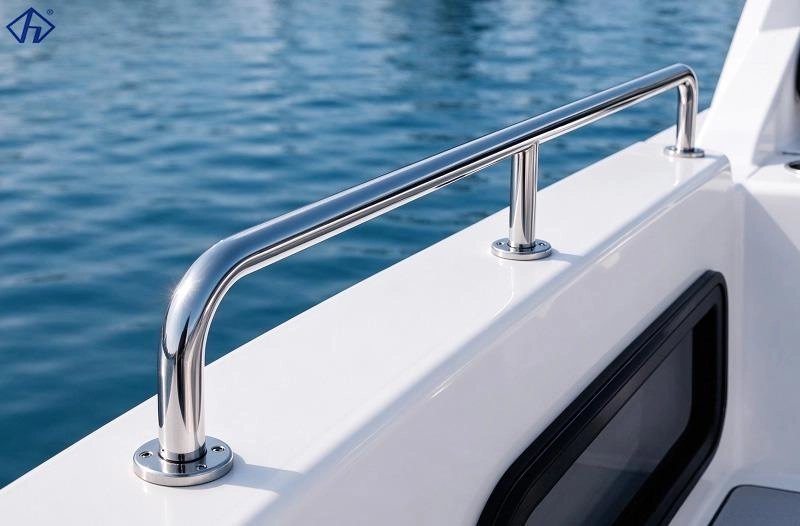
Once a marine handrail has been stripped away, it quickly becomes apparent that there are often differences from the as-built drawing. Hole positions may not line up, a fixing may be obscured under a deck fitting, or the new base will straddle a deck joint. Any of these can lead to additional work to complete the handrail. When considering a marine handrail retrofit, it is therefore important to consider if the overall arrangement of handrail, fixings, deck holes and services can all continue to function.
To get a meaningful price back from a marine hardware house for a given handrail retrofit, the purchaser should be able to collate some key data. These will depend on the specifics of each case but typically include: handrail route, existing hole locations, rail tubing size(s), base plate size and any other relevant constraints, plus the exposure of the fixings. With that information, the marine hardware house will be assessing a true ‘live’ scenario. The HIEVER Marine Hardware collection allows the customer to assess the various fittings and associated spares that may be required, subject to the measured situation and customer’s desired metallurgy and surface.
What data should be collected to ensure the handrail fits the previous holes?
Firstly, obtain the critical dimensions of the existing handrail fixings. The distances between fixing holes (i.e. C/C) and from the fixing holes to the axis of the rail should be determined. Similarly, the maximum area available for the fixing base should be established. Images taken looking down on and to the side of the existing handrail fixing will also be helpful, provided that an appropriate measuring device is included. Without this, it will not be possible to ascertain whether a proposed replacement will adequately bridge the prior fixing location.
Establish the handrail routing
Determine the handrail route in elevation (plan) and identify all associated posts, gates, steps, landings etc. The rail tubing OD and (if known) thickness should also be noted, along with the required radius of any bends. Depending on the length of straight vs. curved run, quite different fixing requirements may result. Identify any areas that need to be kept free for crew to board the boat, mooring lines etc.
Note any conflict between the boat’s original design and the ‘as found’ condition
If there is a conflict, take the as-found position as being the basis for the subsequent work. Of course the original design will form part of the information collated, but should not be relied upon if the boat has previously been worked on and the deck altered. Doing so will help avoid receiving stainless handrail fixings that correspond to an advertised picture, but fail to suit the particular boat.
What about the impact of the handrail on the boat’s deck openings and services?
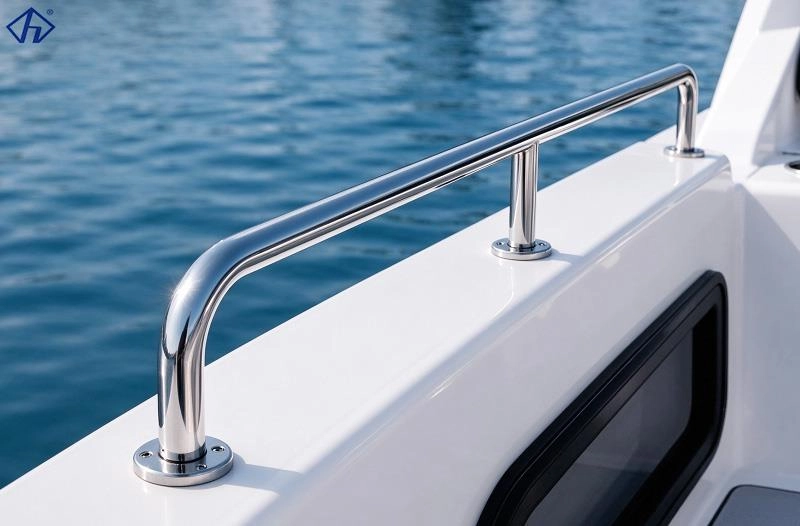
In addition to the distance between fixing holes, the handrail fixing will likely abut other features such as a hatch, batten, winch, porthole or deck panel. An increased fixing base size could occlude an existing opening, while reducing the size might reveal underlying defects. Noting the extent and orientation of the required fixings will be useful here.
Carry out a ‘dry run’ of the proposed replacement
Lay a suitable representation (e.g. card) of the intended replacement over the existing handrail fixing. Open all surrounding hatches, panels and other movable features and ensure that they operate freely. Confirm that adequate space exists for the correct tool to be applied to the relevant fixings and that there is sufficient clearance for hands to engage with the rail. As a last resort, this assessment may be possible prior to receipt of the replacement.
Be cautious of altering the size and nature of the deck fixings if the construction of the boat cannot be positively ascertained.
It would be prudent to seek clarification from the party carrying out the work (or alternatively, the boat owner) as to the extent and type of fixing required. While the marine hardware house will be happy to advise on the equivalent product, no conclusions can be drawn regarding hidden construction from imagery alone.
How should the customer consider corrosion and other materials?
Obviously, the level of corrosion risk will dictate the choice of metal(s). The customer should declare whether the handrail fixing is located e.g. internally, on a wash-down deck or fully exposed. In turn, they should specify the other metals and surfaces in proximity. Failure to do so may result in trapped water, compromised platings and coatings and galvanic action between dissimilar metals.
As we talked about, customers shouldn’t just say “stainless steel” – they should state exactly what grade and finish requirements they want. You can check the related informtion according to the vessel’s records and the existing handrail. It’s best if the customer can get the datas from the original part or the related purchase order. If can not get, they need to make that clear and not assume any standard applies. The handrail shall be accessible for the customer’s routine inspections. Some base assemblies require the top cover to be removed for fastener inspection. The customer needs to confirm this operation is feasible and keep a record.
What information should the customer provide to facilitate a competitive tender?
A common information pack to the relevant marine hardware house will be beneficial. This should comprise the information outlined above, including the number and description of each handrail fixing, the intended site of supply and the target completion date. The customer should clearly distinguish between known and TBC data. This will minimize the risk of the marine hardware house issuing a tender based on inferred dimensions once the handrail has been removed.
If possible, the customer should supply one or more of the original handrail fixings for reference. Close-up images should also be taken to capture the profile, fixing configuration and branding (if applicable) of the underside of the handrail. Where the retrofit relates to an isolated instance, the customer should consider whether the adjacent handrail fixings need to correspond. On some occasions, an existing handrail leg will need to remain, whereas a longer continuous handrail will offer greater flexibility.
Finally, the customer should reconcile the tenders received to the original information pack and query any assumed dimensions. They should also enquire how any alternative products can be ratified, ideally with a sample for comparison prior to despatch of the full order. The HIEVER Marine Hardware collection can be accessed via the main web pages or direct enquiry.
Customers are encouraged to attach the relevant design and photographic information to their request.
Once the handrail retrofit is finished, the customer need to put these documents together: agreed design and information pack, supplier response, sample details and ‘as installed’ images. We should pay attentions to the deviations from the initial design, along with the sign-off. This will allow the information pack to be amended and used as a template for future vessels.
Keeping this baseline record will help prevent the same problem from happening again across all equipment. At minimum, they should record the boat and position of the handrail, key details of the fixings and their surface, and the date and inspection frequency.
All in all, a good handrail retrofit will start and end with accurate dimensional data and a suitable record to inform future works. The product images will act as a guide, but it is the customer’s responsibility to verify that the handrail and associated fixings can integrate satisfactorily into the specific situation. Once satisfied, the customer will be in a strong position to evaluate the options offered by the marine hardware houses.
Customers should submit the relevant deck design, dimensions and pictures of the affected area via the Marine Hardware Enquiry facility. The HIEVER Marine Hardware collection can then be considered in light of the site-specific considerations.
FAQs
Q1: Will I be able to utilize my boat’s existing handrail fixing holes?
A1: Provided that the fixing hole C/C, base size, handrail design and deck construction permit.
Q2: What information do I need to share to enable a marine hardware house to price my retrofit?
A2: As a minimum, images of the relevant area with a known dimension, design of the handrail, dimensions of the tubing, desired metal and surface, quantities and any surrounding restrictions.
Q3: Do I need to state the stainless steel specification I require for my handrail fixings?
A3: Ideally, yes. The customer should refer to the boat’s database and existing handrail fixings to establish the appropriate metal and surface. If unable to determine this, the customer should flag this to the supplier.



Leave a comments